
Content
The Digital Discovery Assessment as a building block for the implementation of SAP Cloud ERP
Anyone planning to implement SAP Cloud ERP will usually start thinking about business processes, functionalities and the future scope of the system at an early stage. Which processes should be mapped in SAP in the future? Which requirements are business critical? Which countries need to be taken into account? And how closely do the company’s own requirements actually align with the SAP standard?
These questions should not be left until the implementation phase to be answered. Beforehand, it is important to develop a shared understanding of what is to be covered by SAP Cloud ERP (S/4HANA Public Cloud) in the future.
The Digital Discovery Assessment (DDA) plays an important role in this process. It helps to systematically define the potential scope of an SAP Cloud ERP implementation.
However, the DDA should not be considered in isolation. The assessment does not mark the end of the functional analysis. Instead, it provides an initial scope that is subsequently reviewed and refined in Fit-to-Standard workshops.
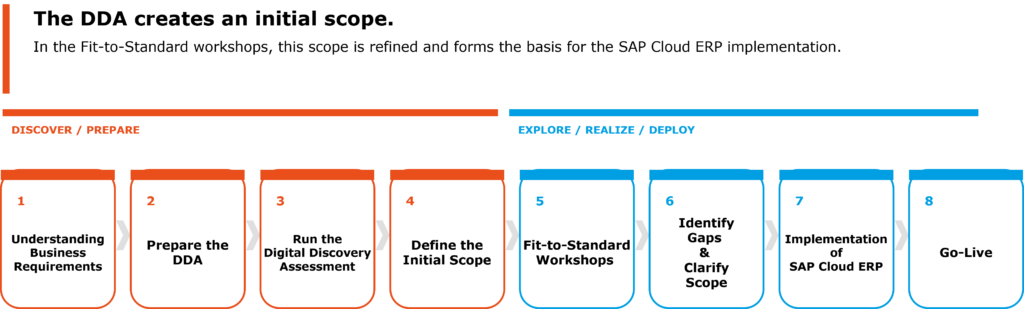
The key question is therefore not simply: How do we carry out a DDA? Rather: How can we use the DDA as a starting point for a successful SAP Cloud ERP implementation?
What is the Digital Discovery Assessment?
The Digital Discovery Assessment is a structured approach for determining the potential scope of an SAP Cloud ERP implementation (S/4HANA Public Cloud).
It is not simply about identifying individual functional requirements. Instead, the DDA considers which business areas, processes, countries and SAP solutions are relevant for the future system.
For example, it can be used to assess:
- Which business areas and end-to-end processes should be supported by SAP Cloud ERP?
- Which Scope Items are relevant to the company?
- In which countries or regions should the solution be deployed?
- Which localisations are required?
- Which other SAP solutions and integrations need to be considered?
- Which requirements have a particularly high priority for the planned implementation?
The result is a structured initial scope that serves as the basis for the subsequent SAP Cloud ERP implementation.
The overview within the DDA also shows how the different scope dimensions are brought together. In addition to the solutions considered, it displays, for example, localisations and selected Lines of Business (business areas) or Scope Items.
A Scope Item describes a predefined business process or process scope in SAP Cloud ERP, such as a specific procurement, sales or finance process. In the Digital Discovery Assessment, the Scope Items relevant to the company are selected. Together, they form a key part of the initial scope of the future SAP Cloud ERP solution.
Additional details for each Scope Item can be accessed via an information button. These details explain which business process or functionality the Scope Item covers. They also indicate whether additional products or licences are required for its use and whether this may result in additional licence or product costs. This information should be taken into account when selecting the scope, as activating a Scope Item can therefore affect not only the functional scope, but also the required solution and licensing landscape.
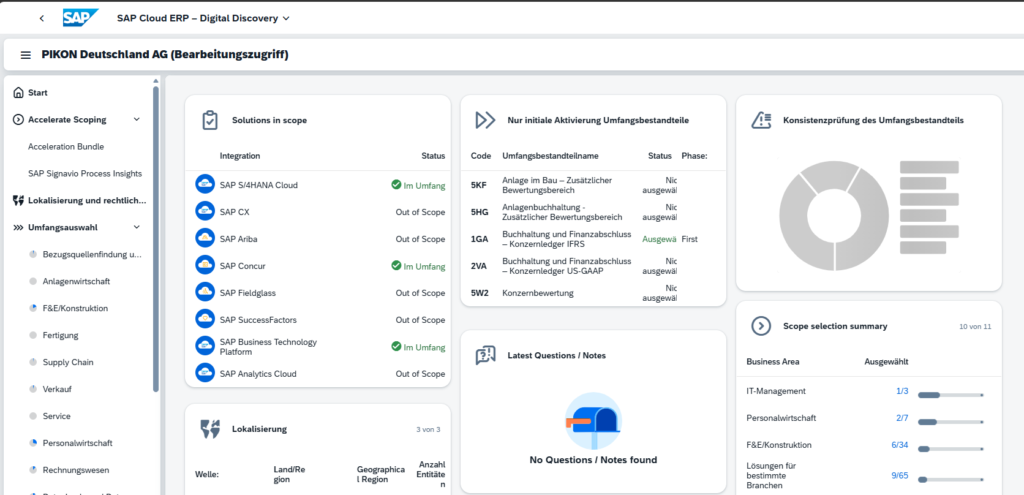
In addition, the DDA provides the basis for SAP’s or a certified partner’s licensing proposal, as the required licence scope and associated costs are determined based on the scope identified.
Whitepaper
The Practical Guide to Your Public Cloud Journey
The whitepaper explores the opportunities and challenges of SAP S/4HANA Cloud Public Edition. It also covers strategic considerations when selecting the target architecture and provides a structured approach to implementation based on the SAP Activate phases.
Thinking from the Standard: Baseline and ERP Scenarios
An important principle when implementing SAP Cloud ERP is Fit-to-Standard.
In classic ERP projects, the focus was often on how existing processes and requirements could be replicated as accurately as possible in the new system. With a Cloud ERP implementation, this perspective changes. The key question becomes:
Which of our business requirements can we sensibly map using the SAP standard processes provided?
This approach is already reflected in the DDA. Preconfigured packages or a baseline can be used as a starting point for scoping. The tool also offers various preselected ERP scenarios, such as a finance-led, service-centric or product-centric ERP.
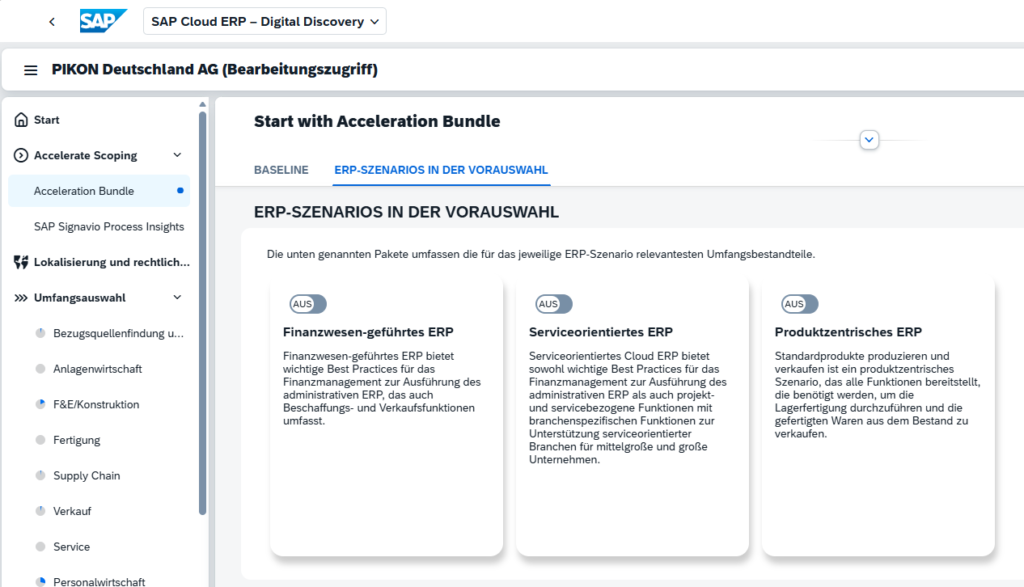
Scoping therefore does not start with a blank sheet of paper. Instead, the SAP standard provides a starting point, which is then aligned with the requirements of the respective company. And this is precisely where preparation becomes important.
Before it can be decided which standard processes are relevant, it must first be clear what business requirements the company actually has.
Which Business Processes belong in the Scope?
As we go on, the analysis gets more specific.
Within the various Lines of Business, individual Scope Items can be reviewed and selected for the planned solution. If an ERP scenario has already been selected in advance, the Scope Items relevant to that scenario will already be activated.
The screenshots provided illustrate this, for example, for the area of R&D/Engineering and the different project management scenarios available there.
For selected Scope Items, details such as priority and phase can be recorded.
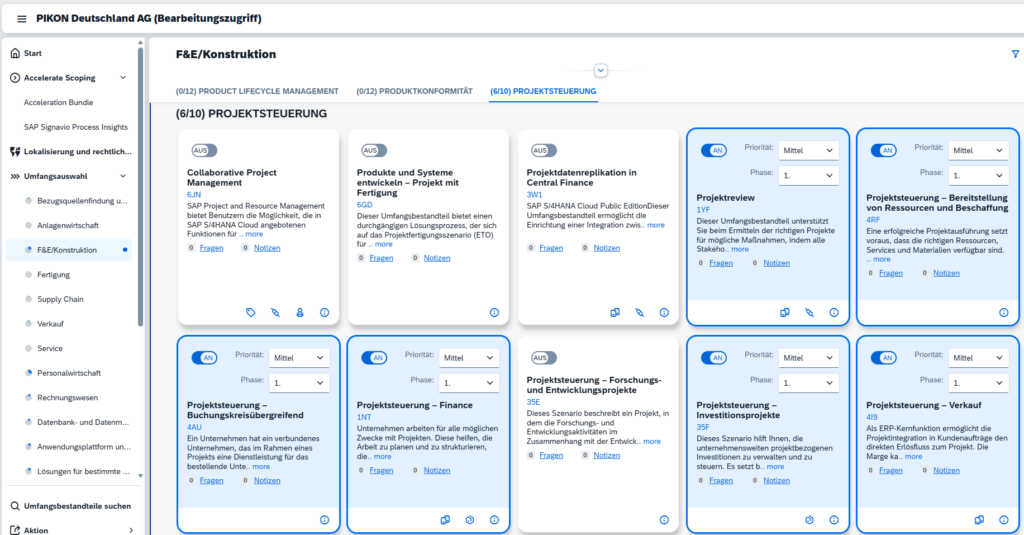
From a technical perspective, making a selection is quick and easy. From a functional perspective, however, this involves a much more complex decision.
The aim is not to select as many functionalities as possible. Nor should the functionality of an existing ERP system simply be transferred to the new solution.
Instead, questions such as these should be answered:
- Which processes do we actually need for our business model?
- Which requirements distinguish us from the standard?
- Which current specific requirements are genuinely business critical, and which have simply evolved over time?
- Where are we prepared to adapt our processes to the SAP standard?
This is also where the importance of functional preparation for a DDA becomes clear. The better the business processes and requirements are understood and prioritised, the more well-founded the initial scope can be.
International SAP Cloud ERP Implementation: Consider Localisations at an early stage
For internationally operating companies, there is another dimension to consider: A business process does not necessarily run the same way in every country.
This is why localisations are also considered in the DDA.
For example, companies can specify which countries or regions should be included in the planned implementation. The screenshots provided show, among others, Germany, Belgium and the United Kingdom.
Based on this, a localisation matrix can be used to determine which Scope Items are relevant or available for the respective local versions.
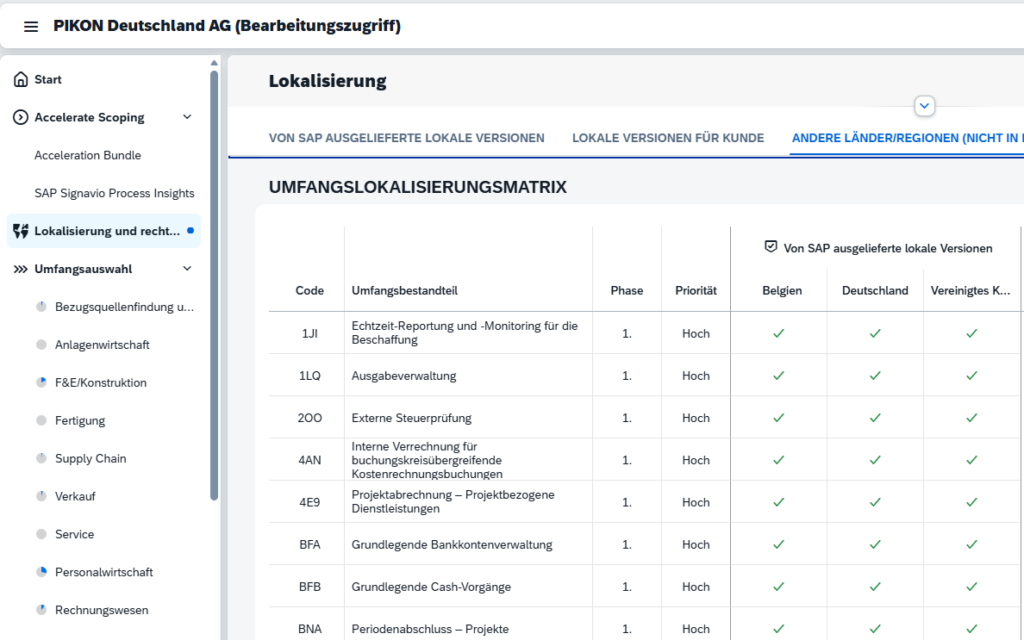
This aspect should not be underestimated, particularly in international rollouts. Country specific requirements can have an impact on the planned scope and subsequent implementation.
Questions regarding the international set up should therefore be addressed at an early stage:
- Which companies or legal entities should use SAP Cloud ERP?
- Which countries will be introduced in which phase?
- Which local requirements need to be considered during planning?
The DDA therefore makes one thing clear: Scoping means more than selecting processes. Business processes, organisational requirements and international conditions need to be considered together.
Using existing SAP Processes as additional Input
For companies with an existing SAP landscape, another interesting question arises:
What can we learn from how the system is used today for the future SAP Cloud ERP solution?
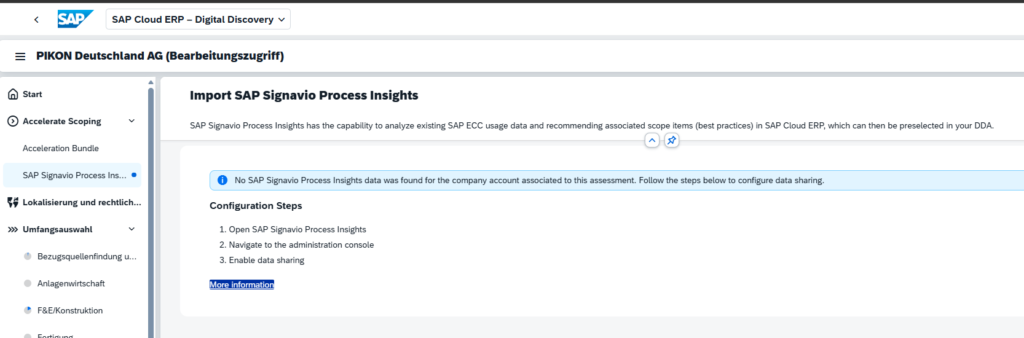
The DDA provides for integration with SAP Signavio Process Insights for this purpose. According to the description shown in the tool, existing SAP ECC usage data can be analysed and corresponding Scope Items or best practices for SAP Cloud ERP can be suggested based on this analysis. These can then be preselected in the DDA.
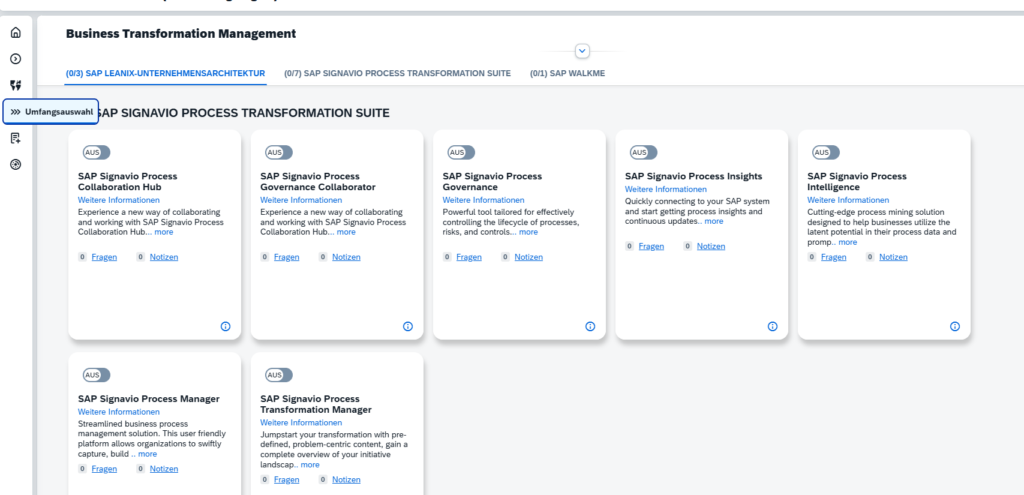
This can provide a valuable additional source of information. However, it should not lead to a false conclusion:
Just because a process is used today does not mean it has to be continued in the same way tomorrow.
An SAP Cloud ERP implementation in particular provides an opportunity to critically review existing processes. Usage data can therefore provide valuable insights and support the discussion. However, it does not replace the functional assessment of future processes.
The DDA is the Starting Point, not the final Project Scope
Once the relevant business areas, scope items, countries and other framework conditions have been selected, a structured initial scope is drawn up.
This establishes an important foundation.
However, it would be a common misconception to equate this scope with the final solution design at this stage.
The DDA defines a starting point for the subsequent implementation, not every detail of the future solution.
This is precisely why, in our process model, the DDA and definition of the initial scope are followed by the next crucial step: the Fit-to-Standard workshops.
From the initial Scope to Fit-to-Standard
In the Fit-to-Standard workshops, the initial scope is examined in greater detail together with the business departments.
At this stage, the primary question is no longer which SAP standard processes are generally relevant. Instead, the focus is on how well these processes meet the company’s specific business requirements.
In simplified terms, three situations can arise:
- Fit: The business requirement can be appropriately mapped using the intended SAP standard process.
- Process adjustment: The SAP standard provides a suitable solution, but the company needs to change an existing process.
- Gap: A business critical requirement cannot be adequately covered by the intended standard. In this case, it must be assessed how this deviation should be addressed.
The second case is particularly important for a Cloud ERP implementation. Not every deviation between an existing process and SAP Cloud ERP automatically represents a functional gap.
Sometimes, it makes more sense to change the company’s own process rather than adapt the future ERP system to historically evolved processes.
This discussion is a key part of the Fit-to-Standard approach.
Identifying Gaps and refining the Scope
It is only through this detailed analysis that the initial scope gradually becomes a robust scope for implementation.
This is why, in our process model, the Fit-to-Standard workshops are explicitly followed by gap identification and scope refinement. Only then does the actual SAP Cloud ERP implementation begin.
This can be reduced to:
- DDA: What could be part of our future SAP Cloud ERP solution?
- Fit-to-Standard: How well do the intended standard processes actually fit our business requirements?
- Implementation: How do we implement the resulting, refined scope?
This distinction is important to ensure that the role of the DDA within the overall project is properly understood.
Good Preparation makes the DDA more valuable
This brings us back to the initial question.
The quality of the scoping process depends to a significant extent on how well a company understands its own requirements.
Companies that enter the discussion unprepared and simply look at the existing system’s functionality risk carrying historically evolved structures over into the new cloud environment.
It is therefore worth establishing clarity on several fundamental points before the DDA:
- Which end-to-end processes are critical to our business model?
- Which requirements are business critical?
- Which specific requirements genuinely distinguish us from the standard?
- Which systems and integrations play a role in the existing landscape?
- Which countries and companies or legal entities need to be considered?
- Which requirements are mandatory and which are merely desirable?
- Where are we prepared to align our processes more closely with the SAP standard?
This is not simply preparation for a tool. It is functional preparation for the future SAP Cloud ERP solution.
Cloud ERP requires a Cloud Mindset!
A successful SAP Cloud ERP implementation is not just a technological change. It often also requires a change in mindset within the organisation. While individual requirements in traditional ERP projects were often implemented through extensive customisation, Cloud ERP follows the Fit-to-Standard and Clean Core principles more closely. Companies therefore need to be prepared to critically review existing processes and align themselves with the SAP standard wherever there is no genuine need for business differentiation.
This Cloud mindset does not only affect IT. It is particularly relevant to business departments and their employees. The key question is no longer simply: “How do we map our current process in the new system?” Instead, it is: “How can we make sensible use of SAP standard processes for our future processes?” This mindset is important already during the DDA and later in the Fit-to-Standard workshops. Otherwise, there is a risk of unnecessarily transferring historically evolved processes and custom solutions into the new Cloud ERP environment.
Change management should therefore be part of the SAP Cloud ERP implementation from the outset. Employees and managers need to understand why processes are changing, what benefits greater standardisation offers and how the transformation will affect their day-to-day work. Early communication, active involvement of the business departments and targeted training and enablement measures help to build acceptance and embed change sustainably within the organisation.
How PIKON supports the Digital Discovery Assessment
The Digital Discovery Assessment should not be viewed as an isolated activity, but as part of an end-to-end SAP Cloud ERP transformation. This is where PIKON’s support comes in.
We do not carry out the formal Digital Discovery Assessment ourselves. Instead, we can involve appropriate certified partners for this purpose.
Our support begins before the DDA: together with you, we structure business processes and requirements, identify relevant questions and prepare the participating business departments for the scoping process. This creates a sound functional basis for the assessment.
After the DDA, we support you in evaluating the resulting initial scope and further developing it as part of the Fit-to-Standard workshops. Together with the business departments, we assess how well the intended SAP standard processes cover the actual business requirements, identify potential gaps and refine the scope as the basis for the subsequent SAP Cloud ERP implementation. In this way, we support the transition from the initial scope through Fit-to-Standard and gap analysis to implementation and a successful go-live.
At the same time, we do not view a Cloud ERP implementation solely from a process and IT perspective. With our Project & Change Excellence team, we support you in embedding organisational change in the project from the very beginning. By involving managers, key users and employees at an early stage, providing target group specific change communication and implementing suitable enablement and training measures, we help to build acceptance of new processes and ways of working. An important part of this is developing a Cloud mindset: moving away from trying to replicate existing processes as individually as possible and towards considering how SAP standard processes can be used effectively for the future organisation. In this way, we also help to embed the Fit-to-Standard approach sustainably within the organisation.
Conclusion: From the initial Scope to a successful Implementation
The Digital Discovery Assessment is an important building block on the journey to SAP Cloud ERP. It creates transparency around which processes, Scope Items, countries and solutions may be relevant for a future implementation. However, its true value lies in how it interacts with the steps before and after the assessment. Companies that understand their business requirements at an early stage, prepare the DDA accordingly and then consistently challenge the initial scope through Fit-to-Standard create a robust foundation for their SAP Cloud ERP implementation.
Book your personal meeting
Our Customer Success Manager, Tanja Nikolaus, supports our customers in their projects in the S/4HANA Public Cloud environment and is happy to take care of your concerns.

You are currently viewing a placeholder content from Active Campaign. To access the actual content, click the button below. Please note that doing so will share data with third-party providers.
More Information