Content
Introduction: The challenges of today’s data landscapes
Over the years, new systems have been implemented, existing applications expanded and additional solutions continually integrated. What was originally intended to drive digitalisation often has the opposite effect today: a complex and confusing IT and data landscape. For many companies, the question is therefore not only which technology is suitable for what, but above all how everything works together effectively.
At the same time, the volume of available data is growing rapidly. Production data, financial metrics, customer data and supply chain information are now generated almost in real time. These are ideal conditions for data-driven decision-making and the use of artificial intelligence. Nevertheless, this potential often remains untapped because data is scattered across different systems and is difficult to consolidate.
This is precisely where the SAP Business Data Cloud (BDC) comes in. It brings together data from SAP and non-SAP systems on a central platform, creates a unified data foundation and makes it available for analysis and AI applications.
But what is the BDC at its core? How is its architecture structured, and what components does it comprise of? This article answers precisely these questions.
Background: What is the SAP Business Data Cloud?
The SAP Business Data Cloud (BDC) is a fully managed Software-as-a-Service (SaaS) platform that is operated, maintained and automatically updated by SAP in the cloud. It brings together data from SAP and non-SAP systems on a central platform, creates a unified and trustworthy data foundation, and makes this data available for modern analytics and AI scenarios. The platform is therefore aimed at companies whose existing data landscapes no longer meet the requirements of modern applications.
Put simply, the SAP Business Data Cloud can be described as a data layer between business applications and analytics and AI applications. It acts as a central intermediary between operational business processes and data-driven innovations. Business applications generate the relevant corporate data, which is connected, harmonised and managed by the Business Data Cloud. Based on this consolidated data foundation, analytics and AI applications can generate reports, derive forecasts and support intelligent automation.
One important point is often misunderstood: SAP Business Data Cloud is not a single product. Instead, it is a platform that combines a range of SAP technologies. Depending on their requirements, organisations can implement different components and expand their platform step by step. This means they do not need to build a complete target architecture from the outset. Instead, they can start with a small, clearly defined use case and extend the platform as their business needs evolve.
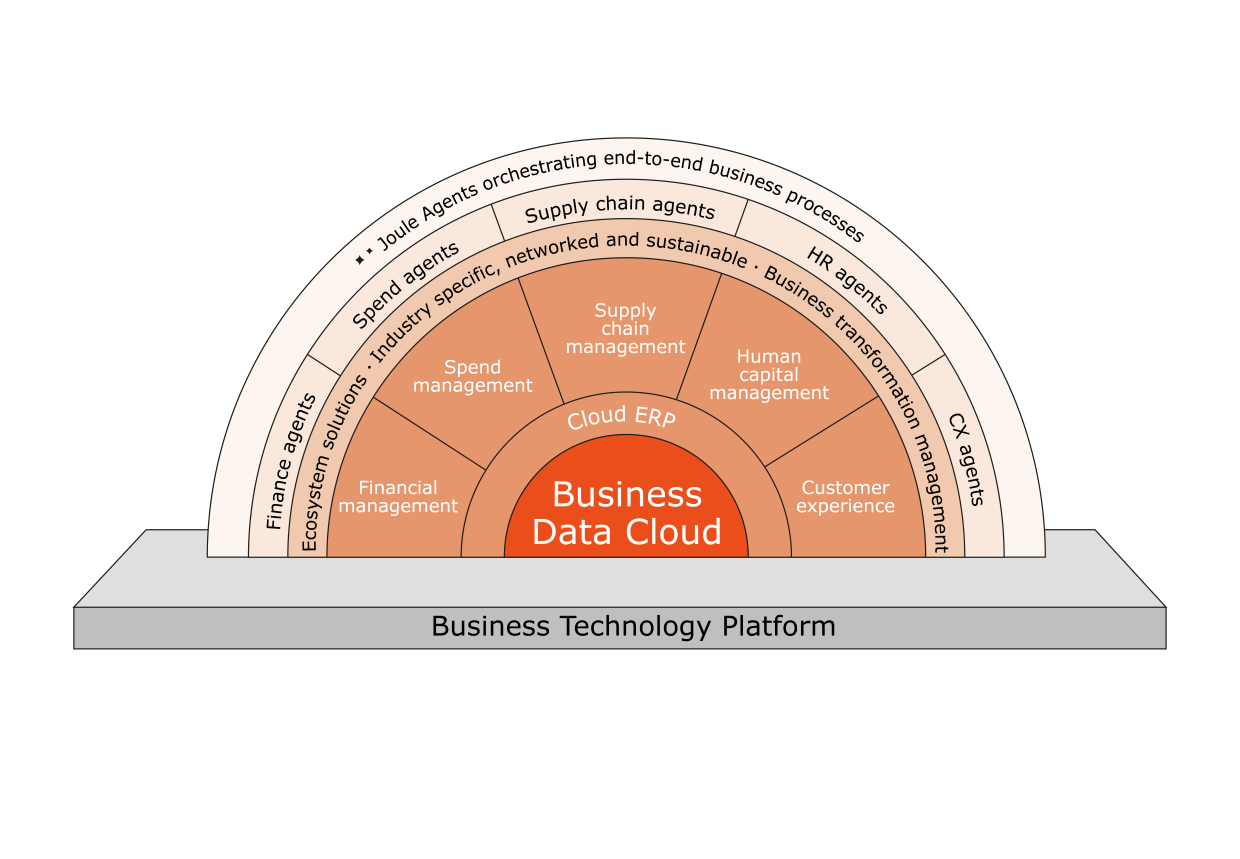
With the introduction of SAP Business Data Cloud, SAP has also refined the positioning of its platform strategy. While many data services were previously part of the SAP Business Technology Platform (BTP), SAP now positions Business Data Cloud as a standalone component of the SAP Business AI Platform. This highlights an important shift: data management is no longer viewed purely as technical infrastructure, but as a fundamental prerequisite for the productive use of artificial intelligence.
Business Data Fabric as a Data Architecture
To fully understand the architecture of SAP Business Data Cloud, it is helpful to first consider the underlying concept of a data architecture. A data architecture defines the structural framework of an organisation’s data landscape. It determines how data is collected, moved, stored, secured and made available for use. This includes data models, standards, policies, storage technologies, security and governance.
Traditionally, organisations have adopted a variety of architectural approaches to manage their data. Data lakes for large volumes of structured and unstructured data, data warehouses for centralised analytics, data marts for the departments, data mesh for decentralised data ownership, and data fabric for connecting distributed data landscapes. Each of these approaches addresses different requirements and offers its own strengths.
With Business Data Cloud, SAP has chosen the data fabric approach. A data fabric is designed to connect data regardless of where it is physically stored. This means data does not have to be copied into a central database. Instead, different data sources are intelligently connected and managed through a common layer. As a result, users experience what appears to be a single, unified data platform, even though the underlying information may remain in multiple systems. Existing SAP and non SAP systems can therefore continue to operate without disruption.
However, SAP takes this concept a step further with Business Data Fabric. The key difference lies in the business context. The objective is not simply to connect data from a technical perspective, but also to preserve business logic, relationships, hierarchies, key figures and calculations. SAP describes this as preserving the “DNA of the data”. Common governance rules, shared metadata and consistent business definitions ensure that different departments work with the same information. This significantly reduces discussions about which key figure represents the “correct” version of the truth.
This approach is particularly valuable for AI applications. Modern AI models require more than just large volumes of data, they need data that they can understand. Business Data Fabric provides exactly this foundation by connecting data sources, maintaining data lineage and enriching business processes with semantic context.
Design Principles
SAP BDC can be characterised by a number of design principles:
- Ready to Use Analytical Content: SAP BDC delivers analytical content through Intelligent Applications. These applications provide data rich dashboards with real time data and built in AI capabilities. Business users can ask questions in natural language and receive not only direct answers, but also additional insights into potential relationships and patterns.
- Data Product Economy: Data is no longer treated as raw tables, but as reusable data products. A data product is cleansed, enriched, packaged and complemented with metadata. It is business ready and can be used for analytics or AI with minimal preparation. SAP provides certified, ready to use data products based on SAP applications. In addition, organisations can create their own customer data products by combining organisation specific information from SAP and non SAP sources for tailored analytics and AI use cases.
- One Domain Model: Many SAP applications contain similar business objects but define them differently. For example, an object may be referred to as a Material in one system and as a Product in another. SAP Business Data Cloud harmonises these definitions within a shared domain model, allowing business users to work with consistent business objects without needing to know which source system they originate from.
- Open Data Ecosystem: SAP recognises that most organisations operate more than just SAP systems. Business Data Cloud therefore supports partner platforms and bidirectional data exchange. This is particularly important for AI and machine learning projects, which typically require comprehensive datasets from both SAP and non SAP sources.
- Delta Sharing and Zero Copy: SAP Business Data Cloud uses Delta Sharing as an open standard for sharing live data without creating unnecessary copies. The data remains under the governance of SAP Business Data Cloud and is made available only to authorised consumers.
- Storage at Scale: SAP Business Data Cloud uses a lakehouse architecture based on SAP HANA Data Lake. Storage and compute are separated, enabling large volumes of data to be stored in a highly scalable and cost efficient manner.
- A Solution for Multiple Personas: SAP Business Data Cloud is designed for more than just IT specialists. It supports a wide range of user groups, including data modellers, business analysts, data scientists, SAP developers, administrators and business users. This enables everyone to work from the same trusted data foundation while using the platform according to their specific roles and responsibilities
The key components
The SAP Business Data Cloud combines existing SAP solutions with new components and partner technologies:
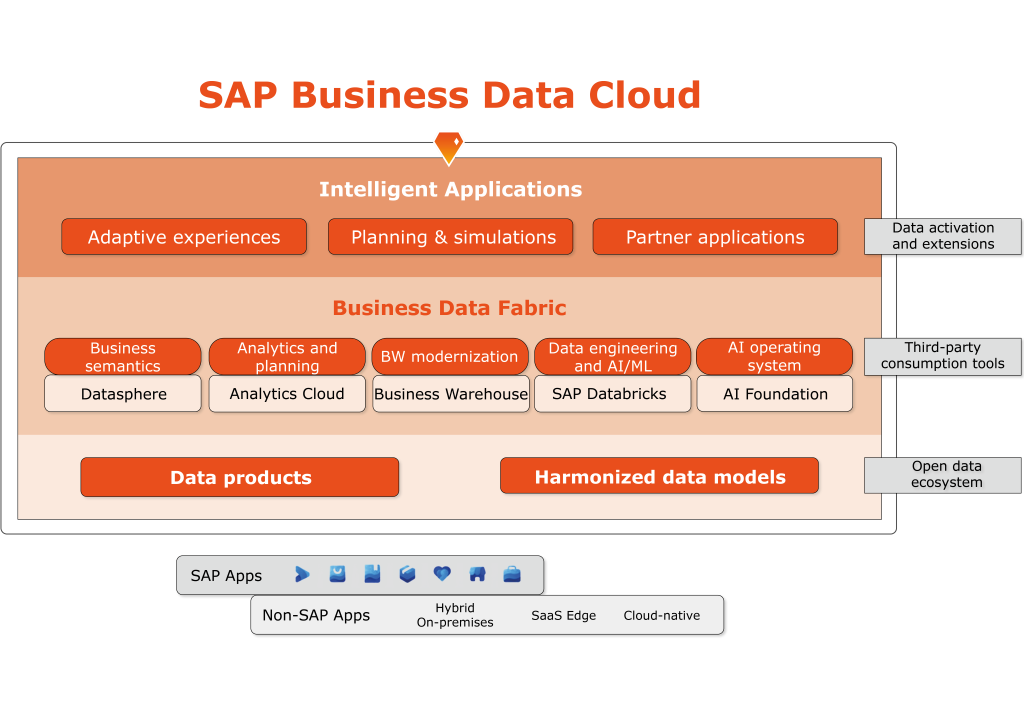
- Object Store: The Object Store provides scalable storage for large volumes of data and unstructured data. It forms the storage foundation of the lakehouse architecture and serves as the repository for SAP Data Products and Customer Data Products. From there, these data products can be used for analytics, planning and Business AI applications.
- SAP HANA Cloud: SAP HANA Cloud provides the technical foundation for data storage and data processing. In addition to in memory computing, it includes Data Lake Storage and supports relational, graph, vector and spatial data models.
- SAP BW Private Cloud Edition (SAP BW PCE): Organisations can continue to use their existing BW landscapes and integrate them into SAP Business Data Cloud. Using the Data Product Generator, existing BW models can be published as data products and made available for further use in SAP Datasphere, SAP Analytics Cloud and Business AI applications. This provides a seamless modernisation path for existing BW environments.
- SAP Datasphere: SAP Datasphere serves as the central data management and modelling layer of SAP Business Data Cloud. It is used to manage data products, integrate data from SAP and non SAP systems, and create semantic data models. In addition, SAP Datasphere provides analytical role based access control.
- SAP Knowledge Graph: SAP Knowledge Graph links data, metadata and business objects, establishing the relationships between them. This preserves the business context, which is an essential prerequisite for trustworthy analytics and the effective use of Business AI.
- SAP Databricks: SAP Databricks supports data engineering, data science, machine learning and AI workloads. It is particularly aimed at data scientists who want to enrich SAP data using modern machine learning tools.
- SAP Snowflake: Through the integration of Snowflake, organisations can combine SAP data with additional data sources and use it for data science, machine learning and advanced analytical applications.
- SAP Analytics Cloud (SAC): SAP Analytics Cloud provides the visualisation and planning capabilities of the platform. It offers dashboards, stories, ad hoc analysis, planning functionality and AI powered analytical capabilities.
- Intelligent Applications (Insight Apps): Intelligent Applications are preconfigured, AI powered business applications built on Business Data Products. They combine real time data, analytics and Business AI to deliver actionable insights that support data driven decision making.
- SAP AI Foundation: AI Foundation brings together the core AI services within the SAP Business AI Platform. It supports the development of custom AI applications, AI agents and solutions built with Joule Studio.
- SAP BDC Cockpit: The BDC Cockpit provides the central administration interface for the platform. Administrators can configure components, manage content, control authorisations and monitor the overall health of the entire SAP Business Data Cloud landscape.
Conclusion
With SAP Business Data Cloud, SAP provides a platform that enables organisations to modernise their existing data landscape step by step. Rather than replacing existing systems entirely, organisations can connect SAP and non SAP data and use it on a shared data foundation for analytics, planning and Business AI. At the heart of the architecture is the Business Data Fabric approach, which not only connects data but also preserves its business context. This enables SAP Business Data Cloud to provide the foundation for a future ready, trusted and AI enabled data platform.
As many SAP solutions will reach the end of their maintenance lifecycle over the coming years, and AI powered applications continue to become an increasingly important competitive differentiator, the question is no longer whether organisations should modernise their data architecture, but how much longer they can afford to wait.
Contact us!
Do you have further questions? Our experts will be happy to help.
Schedule a web meeting with us — or simply leave your question in the comment section.

You are currently viewing a placeholder content from Active Campaign. To access the actual content, click the button below. Please note that doing so will share data with third-party providers.
More Information