

Content
What does the End of Support for SAP BW 7.5 mean for your Business?
Many organizations are in the same situation: their SAP BW 7.5 system is running reliably, reports are performing as expected, and business users are satisfied. So why change anything?
This is exactly where the challenge lies. Although SAP BW 7.5 continues to operate reliably in many organizations today, the end of support is approaching. At the same time, many companies are uncertain about the practical implications and what a future-proof strategy for their data and analytics landscape should look like.
For IT managers, BI leaders, and SAP architects, this creates a familiar dilemma. On the one hand, the existing system often requires no immediate action from an operational perspective. On the other hand, risks, technological dependencies, and strategic uncertainty continue to increase. In addition, many organizations have yet to define a clear target architecture for their future data platform.
What are the support deadlines for SAP BW 7.5?
SAP BW 7.5 (on-premise) is currently subject to the following support timeline:
- Mainstream Maintenance: until the end of 2027
- Optional Extended Maintenance: until the end of 2030
Extended Maintenance is a paid extension of SAP’s standard support, available until 31 December 2030. It provides organizations with additional time to plan and execute the transition to successor platforms such as SAP BW/4HANA or SAP Datasphere. This can be particularly valuable for organizations with complex system landscapes, where migration projects often require significant preparation and coordination.
However, Extended Maintenance should not be viewed as a long-term strategy. It is a temporary, fee-based extension that postpones—but does not eliminate—the need to modernize your SAP data platform.
For organizations running SAP BW 7.5 in the Private Cloud Edition, SAP has also announced an end of support in 2030.
After these deadlines, support will end permanently. In practice, this means reduced support services, no further security updates, and no functional enhancements.
At the same time, SAP is focusing its strategic investments on modern, cloud-based data platforms. While SAP BW/4HANA remains a supported solution, SAP’s innovation efforts are increasingly centered around offerings such as SAP Business Data Cloud. For organizations, this is a clear signal to reassess the long-term direction of their data and analytics landscape.
Companies with large, complex, and historically grown SAP BW environments often underestimate the lead time required for a successful transformation. The technical migration itself is usually only one part of the project. Equally important are architectural decisions, the optimization of existing data models, alignment with business stakeholders, resource planning, and organizational change management.
Organizations that wait until support is about to expire often find themselves under significant time pressure, making it much more difficult to execute a well-planned and future-proof transformation.
Why should Companies act now?
The principle of “Never change a running system” continues to shape the way many organizations operate.
In the short term, this approach may seem reasonable. However, in the long term, it creates significant technical, organizational, and strategic risks.
Security, Compliance and Cost Risks
As the end of support approaches, organizations face several challenges at the same time:
- Security updates will no longer be available
- Meeting compliance requirements becomes increasingly challenging
- Operating and maintenance costs increase
- Dependence on SAP BW 7.5 specialists grows
There is another important factor to consider: many existing SAP BW landscapes have evolved over many years. Over time, complex data flows, redundant data models, and custom developments have been created, which are often only fully understood by a limited number of experts today. The longer organizations postpone modernization, the more complex and costly a future transformation becomes.
Strategic Opportunities Through Early Modernization
However, focusing solely on the end of support does not tell the whole story. The current situation also presents organizations with an opportunity to fundamentally rethink and realign their overall analytics strategy.
Modern data platforms enable:
- More flexible data integration
- Faster analytics and reporting
- Real-time insights
- Stronger integration of cloud and AI scenarios
Today, business departments increasingly expect greater speed and flexibility than traditional BW architectures were originally designed to provide.
Organizations that take action early therefore achieve more than just technical future readiness. They also create strategic flexibility for innovation, data-driven decision-making, and modern analytics processes.
Which Modernization Paths are available?
There are several different approaches for transforming an existing SAP BW 7.5 system into a future-ready BI landscape.
SAP BW Modernization with SAP BW/4HANA
With SAP BW/4HANA, organizations have access to the established successor to SAP BW 7.5 and the next generation of SAP Business Warehouse.
The solution was specifically developed for SAP HANA’s in-memory architecture and eliminates many of the legacy limitations of traditional BW systems.
This enables organizations to simplify data models and data flows, improve performance, and make the operation and further development of their BW landscape more efficient. In addition, SAP BW/4HANA offers enhanced integration capabilities for modern cloud and analytics scenarios.
Especially for organizations with an established BW environment, SAP BW/4HANA represents a logical evolutionary step. At the same time, the transformation provides an opportunity to critically review historically grown structures and systematically reduce existing complexity.
Not every existing BW object or piece of logic needs to be transferred unchanged. Successful modernization projects often use the migration as an opportunity to simplify data models, restructure processes, and remove unnecessary complexity.
Another important aspect is long-term investment security. SAP BW/4HANA is currently supported until the end of 2040. This provides organizations with a stable foundation for their future data and analytics landscape while giving them sufficient time to strategically shape the further development of their data strategy.
SAP BW Modernization with SAP Business Data Cloud
As part of its cloud-first strategy, SAP has taken a major step forward with the release of SAP Business Data Cloud (SAP BDC). SAP BDC is a fully managed Software-as-a-Service (SaaS) solution designed to unify, harmonize, and provide enterprise data for different business areas — both from SAP systems and third-party applications.
SAP Business Data Cloud combines several components, including SAP Datasphere, SAP Databricks, and SAP Analytics Cloud, to enable seamless and efficient interoperability between different data and analytics solutions. It also enables organizations to integrate existing, historically grown SAP BW environments into SAP Business Data Cloud, allowing them to leverage their existing investments while gradually moving toward a modern, cloud-based data landscape.
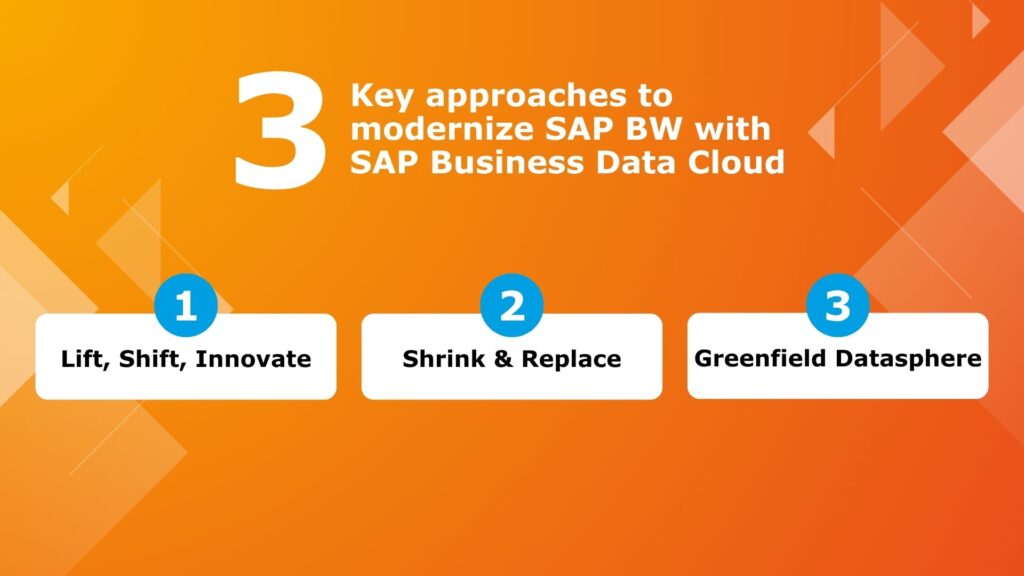
Modernization Approach: “Lift, Shift, Innovate”
The “Lift, Shift, Innovate” approach enables organizations to transition existing SAP BW systems to modern platforms. It allows companies to gradually transform their on-premise BW landscapes into a future-ready SAP Business Data Cloud (BDC) architecture while protecting existing investments.
LIFT: The SAP BW system is moved to the Private Cloud Edition (PCE) as a Platform-as-a-Service environment. SAP provides the integration with SAP Business Data Cloud, while the system landscape and application development remain under the customer’s control. This approach can help reduce the total cost of ownership (TCO).
SHIFT: Existing BW content is transformed into SAP BW data products (using the Data Product Generator). These data products can be reused within SAP Business Data Cloud, provide direct access to the Datasphere Object Store, and enable advanced machine learning and AI scenarios, for example with SAP Databricks.
INNOVATE: While maintaining a Clean Core strategy, organizations gradually transition to SAP-managed data products and intelligent applications. Through Zero Copy scenarios with SAP Datasphere, SAP Databricks, and SAP Analytics Cloud, the legacy BW application can be continuously replaced and modernized.
Modernization Approach: “Shrink & Replace”
The “Shrink & Replace” approach replaces the existing SAP BW system either completely or partially, creating a clean and future-ready foundation with maximum flexibility. However, this approach requires additional effort for manually analyzing, cleaning, and reducing existing data structures. Instead of performing a 1:1 migration, it focuses on eliminating unnecessary complexity and gradually replacing the existing SAP BW environment with cloud-native structures in SAP Business Data Cloud.
- SHRINK: The existing BW system is cleaned up through a comprehensive data audit. Unused reports are removed, and historical data is archived cost-effectively (for example, in the Datasphere Object Store) to significantly reduce the system footprint.
- REPLACE: The reduced, business-critical core is gradually redesigned and rebuilt in SAP Datasphere, typically domain by domain. The existing reporting layer is replaced with SAP Analytics Cloud (SAC).
- DECOMMISSIONING: Once all processes are running stably and have been validated in SAP Business Data Cloud, the legacy BW system can be fully decommissioned. This eliminates technological legacy burdens and significantly reduces operational costs.
Modernization Approach: “Greenfield SAP Datasphere”
The “SAP Datasphere Greenfield approach” represents a complete restart, where the data platform within SAP Business Data Cloud is redesigned and implemented from the ground up. Instead of migrating historical complexities, outdated structures, and complex workflows from an existing SAP BW environment, this approach provides the opportunity to build new data models based on current best practices: lean, agile, and optimized for future requirements.
The approach focuses on establishing a new cloud-based data platform with SAP Datasphere, leveraging the benefits of scalability, modern analytics capabilities, and seamless integration with other SAP solutions.

Checklist "Fom SAP BW or SAP BW/4HANA to SAP Datasphere"
Our checklist helps you find the right migration path from SAP BW or BW/4HANA to SAP Datasphere.
Download
Which Modernisation Path is right for which Scenario?
One of the most important questions for many companies is: Which path is right for us?
Choosing the right modernisation strategy depends heavily on the existing system landscape and the company’s strategic objectives.
- SAP BW/4HANA: Migrating from SAP BW 7.5 to SAP BW/4HANA is particularly worthwhile for companies that have already invested significantly in their BW environment and want to modernise their existing architecture with as little risk as possible. It is a sensible option when complex data models, numerous existing reports and stable ETL processes are to continue being used and gradually enhanced. BW/4HANA provides a long-term supported on-premise or private cloud platform with high performance and limited transformation effort. By contrast, moving to SAP Business Data Cloud is less attractive if there is no cloud strategy in place or if modern data fabric and AI capabilities do not offer immediate business value. In these cases, BW/4HANA represents the more cost-effective and lower-risk modernisation path.
- SAP Business Data Cloud using “Lift, Shift, Innovate”: This SAP-recommended approach is ideal for companies that want to migrate their existing, well-functioning SAP BW systems to modern platforms while minimising business disruption. It is particularly suitable when established data structures are to be preserved while innovative capabilities are introduced step by step.
- SAP Business Data Cloud using “Shrink & Replace”: This strategy is suitable for companies seeking a technological fresh start and maximum flexibility by replacing their existing SAP BW system either partially or entirely. As this approach involves considerable effort, it requires the organisation to allocate dedicated resources for manual data reduction.
- SAP Business Data Cloud using “Greenfield Datasphere”: This approach is aimed at companies that want to start from scratch with a cloud-based SAP Datasphere environment without carrying over legacy structures. It is particularly suitable for organisations seeking maximum scalability, advanced analytics and simplified integration from the outset, based on an entirely new cloud architecture.
How can Organizations ensure a Successful Implementation?
The biggest challenge is often not the technology itself, but rather the right planning approach. Successful modernization projects therefore do not start with a technical migration. They begin with a structured assessment of the current situation. Organizations should first create transparency around their existing systems, data models, custom developments, and processes.
Based on this analysis, a reliable target architecture can be developed. In the context of SAP Business Data Cloud, many organizations are following the “Lift, Shift & Innovate” approach, which SAP recommends as a modernization path.
Criteria for selecting the right Modernization Path
To select the optimal modernization path for an SAP BW landscape, organizations should structure their decision around five key criteria:
- Technological Maturity & Legacy Complexity: A heavily customized and historically grown SAP BW 7.5 environment containing numerous unused or redundant objects (“data zombies”) can benefit from a Shrink & Replace approach or a Greenfield implementation to significantly reduce complexity. Well-maintained BW landscapes, on the other hand, are often better suited for the investment-protecting Lift, Shift & Innovate approach or a direct migration to SAP BW/4HANA.
- Cloud Strategy & Operating Model: If a Cloud-First or Clean Core strategy is a priority, the path typically leads toward SAP Business Data Cloud (BDC) with SAP Datasphere. If organizations prefer an on-premise or private cloud operating model due to regulatory requirements or strategic considerations, a migration to SAP BW/4HANA may provide the appropriate framework.
- Timeline & Investment Security: If there is no immediate time pressure and the priority is securing existing on-premise investments for the long term, migrating to SAP BW/4HANA provides maximum planning security through its maintenance commitment until the end of 2040. This gives organizations sufficient time to define and implement their long-term data strategy.
- Innovation Requirements & Business Needs: If business departments require immediate access to advanced real-time analytics, AI and machine learning scenarios (for example via SAP Databricks), and agile self-service analytics through SAP Analytics Cloud (SAC), moving directly to SAP Business Data Cloud can provide the right foundation.
- Resources & Budget: A Greenfield approach provides the cleanest architecture but requires significant human and financial resources for a complete redesign. In contrast, Lift, Shift & Innovate or a migration to SAP BW/4HANA can reduce implementation risks and minimize manual effort during the transformation process.
A common mistake is starting the transformation too late.
In addition to the technical implementation itself, organizations need sufficient time for strategy development, architecture design, pilot projects, testing, data cleansing, and training.
Best practices from successful projects consistently show that:
- Early roadmap planning significantly reduces risks
- Iterative approaches increase acceptance throughout the organization
The early involvement of business departments is particularly important. Modern data platforms do not only change systems they often also transform processes, responsibilities, and decision-making structures.
Projektmanagement and Change Management
Modernization projects rarely fail solely because of technology.
Challenges often arise from unclear responsibilities, unrealistic timelines, or insufficient communication between IT and business departments.
At the same time, transformation always affects the people within an organization. New data platforms change working methods, reporting processes, and governance structures. Especially for long-time BW users, it is essential to provide transparency and guidance on how their future way of working will evolve.
Organizations should therefore involve key users early, develop training concepts, and actively address potential concerns.
PIKON provides tools to support this transformation process, including our Change Readiness Check and our SAP Key User Concept.
In addition, we support organizations in planning and implementing SAP BW modernization projects and migrating to SAP Business Data Cloud.
What happens after Modernization?
The transformation is often initially viewed as a necessary infrastructure project. However, the real value typically becomes visible after the modernization has been completed. Modern data platforms create the foundation for scalable analytics landscapes, faster data availability, and significantly greater flexibility when integrating new technologies. This results not only in a future-ready architecture but also provides the basis for advanced data analysis, reporting, business intelligence, and AI use cases.
After modernization, organizations can unlock entirely new possibilities, including self-service analytics, real-time reporting, AI-supported analyses, and modern dashboarding and planning scenarios. As a result, IT is increasingly evolving from a pure system operator into a strategic enabler for data-driven decision-making.
Conclusion: Setting the right Direction Now
The end of support for SAP BW 7.5 is more than just a technical deadline.
It requires organizations to actively shape their future data and analytics strategy. Those who take action now can reduce risks, gain planning certainty, and create the foundation for modern, data-driven processes.
The key question is therefore no longer whether organizations need to act, but rather when to act and which target architecture to pursue.
A sensible next step is to focus on three concrete actions:
- Create transparency across the existing SAP BW landscape
- Define a future-oriented data strategy
- Develop a reliable roadmap at an early stage
Successful SAP BW modernization is about much more than a technical upgrade. Sustainable transformation only emerges when technology, processes, and people within the organization are considered together.
This is the key success factor for modern data and analytics projects today.
Contact us!
Do you have further questions? Our experts will be happy to help.
Schedule a web meeting with us — or simply leave your question in the comment section.

You are currently viewing a placeholder content from Active Campaign. To access the actual content, click the button below. Please note that doing so will share data with third-party providers.
More Information