
Content
The Netherlands has one of the most mature e-invoicing environments in Europe when it comes to the public sector. With B2G e-invoicing firmly in place and one of the highest voluntary B2B Peppol adoption rates on the continent, the country has always taken a market-driven approach. That is now changing. Driven by the EU’s VAT in the Digital Age (ViDA) initiative, the Dutch government is moving towards a mandatory B2B e-invoicing regime, with 2030 as the key target year.
What is the current state of Dutch E-Invoicing?
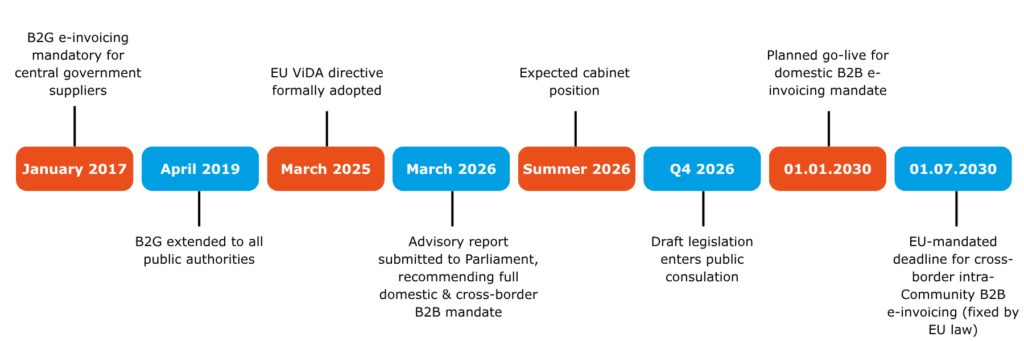
The Netherlands has been one of Europe’s early adopters of electronic invoicing in the public sector. Since 1 January 2017, suppliers to the Dutch central government have been required to submit invoices electronically. This obligation was expanded in April 2019 to include all public sector organizations, including municipalities, provinces, water authorities, and other public bodies.
Electronic invoices are primarily exchanged through the Peppol network using certified Access Points, although certain suppliers continue to use the Dutch government’s Digipoort platform for communication with public authorities. Dutch public entities are required to accept invoices that comply with the European e-invoicing standard EN 16931, as implemented under EU Directive 2014/55/EU.
For the private sector, however, electronic invoicing remains largely voluntary. Businesses are free to exchange invoices electronically, provided both parties agree on the format and method of delivery. Many larger organizations already use structured e-invoicing through Peppol, EDI, or other electronic exchange networks, while small and medium-sized enterprises often continue to rely on PDF invoices sent by email.
Although there is currently no legal obligation for domestic B2B or B2C e-invoicing, adoption continues to grow due to increasing automation, cost savings, and improved invoice processing efficiency.
What is changing and why?
The primary driver behind the upcoming changes is the European Commission’s VAT in the Digital Age (ViDA) initiative. ViDA is one of the most significant VAT reforms introduced by the EU in recent years and aims to modernize VAT reporting, reduce fraud, and simplify cross-border trade within the European Union.
Under the current ViDA proposal, all EU Member States will be required to implement electronic invoicing and Digital Reporting Requirements (DRR) for intra-EU B2B transactions from 1 July 2030. Businesses conducting cross-border trade within the EU will have to issue structured electronic invoices that comply with the European standard and submit transaction data electronically to tax authorities within strict reporting deadlines.
In anticipation of these requirements, the Dutch government has been evaluating whether it should go beyond the minimum EU requirements by introducing mandatory e-invoicing for domestic B2B transactions as well.
An advisory report presented to the Dutch Parliament in March 2026 recommends implementing a nationwide B2B e-invoicing framework based on the Peppol network. The report concludes that extending mandatory e-invoicing to domestic transactions would improve efficiency, reduce administrative costs, increase tax compliance and prepare Dutch businesses for the wider European digital reporting landscape.
The government has indicated that it is broadly supportive of these recommendations. A formal policy response is expected during summer 2026, followed by a public consultation on draft legislation later in Q4 2026. Although no final legislation has yet been adopted, businesses should closely monitor developments, as the Netherlands appears likely to move towards a mandatory B2B e-invoicing framework in the coming years.
Who will be impacted by the changes?
The upcoming changes will primarily affect businesses conducting Business-to-Business (B2B) transactions.
From 1 July 2030, all businesses involved in intra-EU B2B trade will be required to issue structured electronic invoices and comply with the new Digital Reporting Requirements introduced under ViDA.
If the Dutch government proceeds with its proposed domestic mandate, virtually every VAT-registered business operating in the Netherlands would eventually be required to exchange electronic invoices in accordance with the European standard EN 16931, most likely using the Peppol network.
The impact extends beyond finance departments. Organizations should expect changes across multiple business functions.
Businesses currently relying on PDF invoices or manual invoice processing will likely need to modernize their invoicing processes and ERP systems. Organizations already exchanging invoices via Peppol will generally be well positioned, as the proposed framework builds upon the same infrastructure already used for Dutch B2G invoicing.
Preparing early will allow organizations to minimize implementation risks while taking advantage of increased automation and standardized business processes.
How will the Future E-Invoicing Model Work?
To support both the future ViDA requirements and a potential domestic B2B mandate, the Dutch advisory report proposes a standardized technical operating model based on existing European standards and the Peppol infrastructure.
The objective is to create a single, interoperable framework that supports electronic invoice exchange, digital reporting, and future European VAT compliance.
The proposed model consists of four key building blocks:
- Structured electronic invoices compliant with the European standard EN 16931, using supported syntaxes such as UBL (Universal Business Language) or CII (Cross Industry Invoice).
- A 4-corner Peppol exchange model, allowing suppliers and buyers to exchange invoices securely through certified Peppol Access Points rather than direct point-to-point connections.
- A 5-corner reporting model, adding a reporting layer that enables invoice data to be submitted to the Dutch tax authorities for near-real-time Digital Reporting Requirements (DRR) under ViDA. This additional reporting layer is intended to support intra-Community reporting obligations while maintaining interoperability between businesses, service providers, and tax authorities.
- Continued use of internationally recognized standards to ensure compatibility with other European Member States and facilitate cross-border trade.
By extending the existing Peppol framework with digital reporting capabilities, the Netherlands aims to establish a future-proof e-invoicing ecosystem that minimizes administrative burden while supporting both national and European compliance requirements.
Current E-Invoicing Timeline in the Netherlands
How PIKON can help you
With our Competence Center for Legal Requirements, we are a strategic partner who ensures that your SAP system and business processes meet different country-specific legal requirements all over the world in the long run. We have a team of experts that combine SAP expertise and in-depth knowledge of the end-to-end legal process and technical requirements of the Spanish and many other eInvoicing and eAccounting regulations. We have gathered this experience through our many SAP Document & Reporting Compliance and local implementation projects all around the world. Some examples are SDI in Italy, SII in Spain, CFDI and Complemento de Pago in Mexico, RTIR and EKAER in Hungary, XRechnung in Germany, the different legal requirements in Turkey, etc. We have also developed our own compliance SAP Add-Ons e.g. MTD VAT in the UK and the VAT Whitelist in Poland. Furthermore, we always keep an eye on new and changing legal requirements and inform our customers when action is needed. This ensures that your company doesn’t need to follow up on all the legal requirements yourselves, and you can concentrate on your daily business.
More about the E-Invoicing rules in the EU

Whitepaper
Guide to E-Invoicing requirements within the EU
This E-Invoicing in Europe guide provides a clear overview of upcoming regulatory changes across the 27 countries in the EU with SAP DRC, including key mandates and what they mean for your organisation. It helps you align finance, tax and IT discussions and prepare for the next wave of EU E-Invoicing requirements.
Schedule a web meeting
If you have any questions on the Netherland’s E-Invoicing regulations, or if you are interested in a system demo regarding the E-Invoicing flow, do not hesitate to request a web meeting or leave a comment in the comments section below. We are happy to help and will come back to you as soon as possible.

"*" indicates required fields